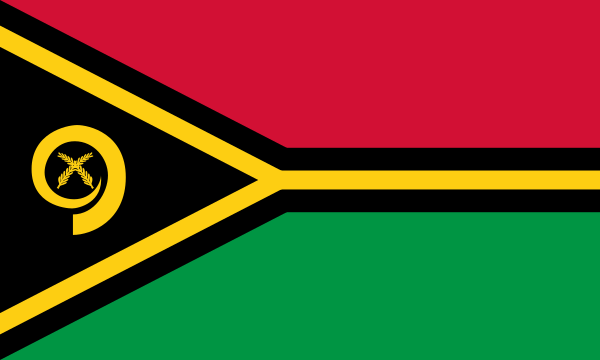
Vanuatu
6% · StableIt is unlikely (roughly 5–10%) that Vanuatu will be directly involved in significant armed conflict within the next three years, with risk concentrated in low-probability regional escalation and disaster-driven governance stress rather than deliberate warfighting choices by Port Vila.
**Bottom line** Vanuatu has no active interstate disputes, no standing military, and security forces optimized for policing, maritime enforcement, and disaster…
Most likely: continued calm with security activity centered on reconstruction support, policing, and maritime enforcement. Political churn and fiscal pressure may produce protests or localized disorder, but organized armed violence remains unlikely. External competition will show up more as aid/infrastructure bargaining and cyber/disinformation attempts than kinetic threats. Any partner security cooperation is most likely training, surveillance, and disaster-response support.
Over five years, repeated climate/disaster shocks and governance fragmentation could incrementally raise instability risk, especially if revenues (including citizenship-program inflows) fall sharply or reconstruction stalls. Even so, a shift to significant armed conflict remains a low-probability tail event absent a major regional war that militarizes the wider Pacific. The most plausible security deterioration pathway is chronic capacity strain, not insurgency or interstate war.
Security situation Vanuatu’s baseline remains very low risk for direct involvement in significant armed conflict. Geography, limited strategic targets, and minimal force-projection capacity constrain both external attack incentives and Vanuatu’s ability to join wars abroad. Security institutions are primarily police-led (including a paramilitary police element) and oriented toward internal order, maritime policing, and humanitarian assistance.
Threat drivers The main external driver is indirect exposure to Indo-Pacific strategic competition. Vanuatu’s infrastructure and security partnerships attract attention from multiple powers, raising risks of coercive diplomacy, influence operations, and cyber intrusion. These dynamics can heighten political friction but typically remain below the threshold of armed conflict, especially in small island states without contested borders.
The main internal driver is compounding shock risk: earthquakes/cyclones, fiscal strain, and political fragmentation can degrade service delivery and legitimacy. Recent analysis emphasizes repeated government turnover and reconstruction bottlenecks, which can elevate protest risk and opportunistic criminality. However, Vanuatu lacks organized insurgent actors, has no terrorism history, and demonstrations are generally limited; unrest is more plausibly episodic than militarized.
Resilience and systemic firebreaks Firebreaks dominate. Vanuatu is embedded in a dense regional diplomatic and assistance ecosystem (Pacific partners and donors) that strongly incentivizes de-escalation and rapid crisis support after disasters. External security cooperation—especially capacity-building in policing and maritime surveillance—tends to improve internal stability and border control rather than create expeditionary entanglements. International norms and the absence of alliance obligations that mandate combat deployments further reduce direct war involvement.
Net assessment Compared with the baseline, evidence modestly increases concern about governance capacity under repeated shocks, but not enough to shift the overall category: direct involvement in significant armed conflict remains unlikely. Tail risk is a severe regional crisis that militarizes the wider Pacific and forces hard basing/overflight choices; even then, Vanuatu’s most likely role is diplomatic and logistical, not combatant.
Support the Project
WarRiskIndex is a public-good initiative. Your contribution powers AI analysis.