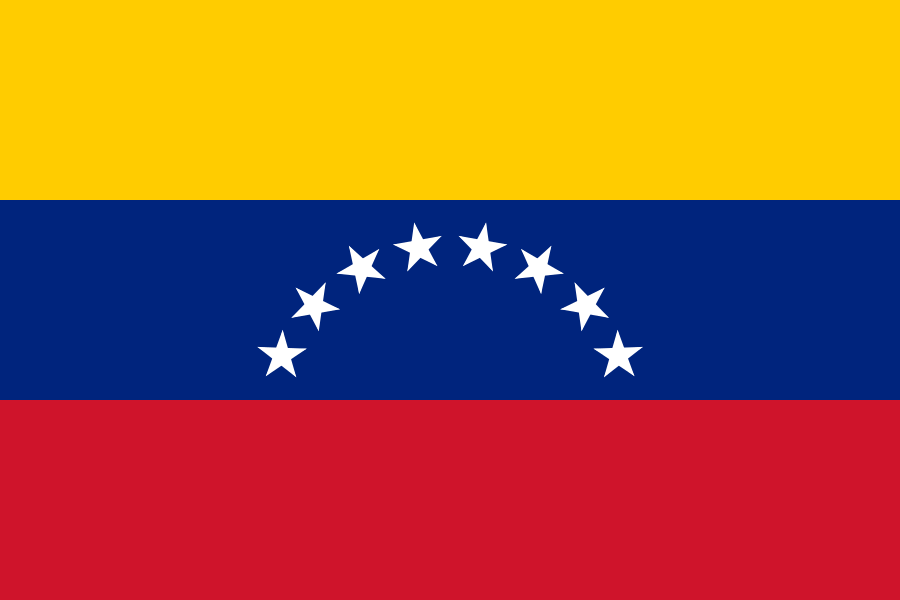
Venezuela
55% · High TensionVenezuela is assessed as more likely than not to be directly involved in at least one significant armed conflict episode within the next three years, driven primarily by renewed U.S.-Venezuela kinetic confrontation risk and secondary border/maritime flashpoints.
**Bottom line** New reporting indicates Venezuela has already experienced U
Near-term risk is elevated because the confrontation cycle appears active and politically salient. The most likely conflict form is another limited U.S. strike/raid or interdiction escalation, potentially paired with cyber effects, followed by Venezuelan asymmetric retaliation or intensified internal security operations. Watch for maritime/air incidents, tightened emergency decrees, and border force movements near Colombia and Guyana.
Over five years, risk depends on regime succession and the durability of U.S. coercive strategy. If a stable governing arrangement consolidates and sanctions pathways reopen, kinetic risk can fall back toward episodic crisis levels. If fragmentation deepens or external actors pursue repeated decapitation/coercion operations, Venezuela could see recurring limited strikes and cross-border incidents, with persistent spillover into neighbors.
Security situation Venezuela’s war risk is dominated by externally initiated escalation rather than a self-started conventional campaign. The retrieval pack’s central update is the claim of a January 2026 U.S. strike/raid (“Operation Absolute Resolve”) and subsequent emergency measures in Caracas. If accurate, this shifts the baseline from hypothetical intervention risk to a demonstrated pattern of kinetic action, lowering political and operational barriers to recurrence.
Threat drivers The highest-impact driver is a continuing U.S.-Venezuela confrontation cycle: sanctions and interdictions, cyber-enabled coercion, and episodic strikes aimed at leadership, air defenses, or trafficking-linked networks. Venezuela’s likely responses are asymmetric (militia mobilization, internal repression, harassment of U.S./partner assets, deniable actions) rather than sustained maneuver warfare, but even brief exchanges meet the threshold for significant armed conflict.
Secondary drivers persist. The Essequibo/Guyana dispute remains a structural flashpoint where maritime incidents around energy assets could escalate quickly. The Colombia border remains porous and contested by armed groups and illicit economies; Colombian offensives or spillover violence can generate cross-border incidents and escalation pressure.
Resilience and systemic firebreaks Venezuela’s conventional limits, fiscal constraints, and regime incentives to prioritize internal control still reduce the probability of prolonged interstate war. Regional norms and mediation channels in the Americas generally favor de-escalation. Extra-regional partners (Russia, China, Iran) provide political cover and selective support but have limited ability to project decisive force, which can deter maximalist moves while not preventing short, sharp clashes.
Net assessment Compared with the prior baseline, the risk balance shifts upward because the most dangerous pathway (U.S.-initiated kinetic action) appears less speculative and more repeatable. The modal outcome remains episodic, bounded conflict rather than sustained war, but the probability of at least one significant armed conflict episode within three years is now assessed above 50%.
Support the Project
WarRiskIndex is a public-good initiative. Your contribution powers AI analysis.