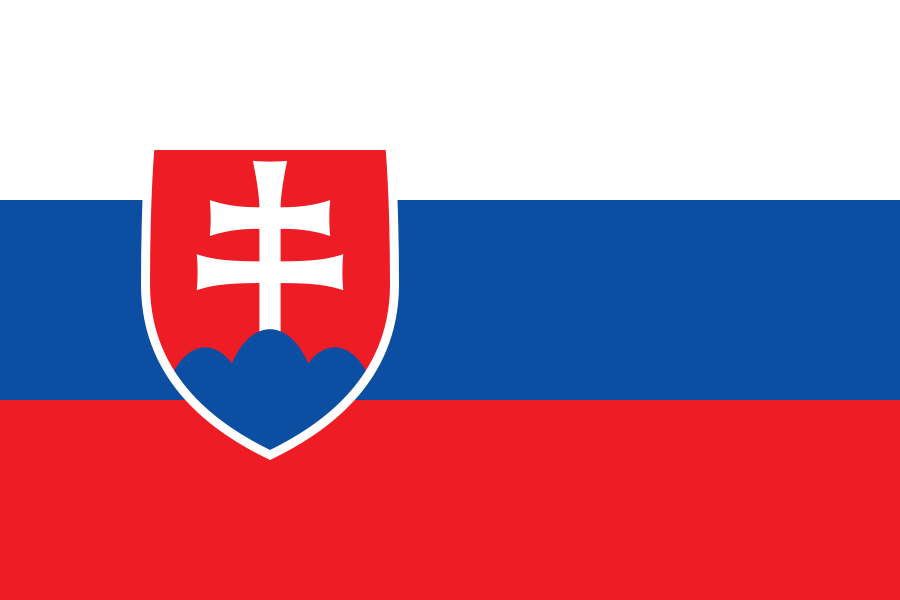
Slovakia
16% · Low RiskSlovakia’s likelihood of direct involvement in significant armed conflict within the next three years is assessed at 16% (unlikely), with risk concentrated in low-probability Russia–NATO escalation or Ukraine-war spillover scenarios rather than domestic conflict dynamics.
**Core judgment** Three-year war risk holds at 16%
Significant armed conflict involving Slovakia is unlikely in the next year. Key kinetic risks are isolated Ukraine-war spillover (debris/drones, airspace incidents) and miscalculation during elevated eastern-flank alerting. Hybrid disruption remains more plausible than open violence, highlighted by recent ransomware impacts on state services. NATO forward presence and ongoing IAMD modernization improve deterrence and incident containment.
Over five years, Slovakia’s exposure tracks the Russia–NATO relationship and the durability of European deterrence, especially integrated air and missile defence and military mobility. If Russia sustains coercive probing and destructive cyber operations, Slovakia faces higher crisis frequency but still mostly below-war thresholds. If NATO posture and Slovak resilience reforms mature, direct kinetic involvement remains a low-probability tail risk.
Bottom line Slovakia has no independent territorial dispute or revisionist war aim; direct conflict risk is almost entirely derivative of wider Russia–NATO dynamics. New evidence since the baseline strengthens the hybrid-threat picture but also strengthens resilience measures; net risk stays broadly unchanged.
Threat drivers The dominant tail risk remains Ukraine-war spillover and miscalculation: airspace violations, debris/drone impacts, or misidentification during heightened air-defence alerting. A second pathway is gray-zone coercion (cyber sabotage, disinformation, covert action) that degrades decision-making and increases the chance of escalation from an ambiguous incident. The ransomware disruption of a core state register and reporting on destructive cyber tools used against regional critical infrastructure reinforce that Slovakia sits inside an active contest space, even if most activity remains below the armed-conflict threshold.
Alliance exposure vs direct kinetic involvement NATO forward presence in Slovakia and broader eastern-flank vigilance improve deterrence but also increase operational tempo and the number of moving parts during crises. This raises the importance of deconfliction, air policing, and command-and-control clarity. Direct Slovak combat involvement would most plausibly occur under Article 5 conditions or a rapidly escalating cross-border incident, not through discretionary Slovak expeditionary choices.
Domestic stability and internal conflict risk Protests and rule-of-law disputes indicate elevated polarization and lower institutional trust, which can complicate crisis communication and continuity of governance. However, Slovakia still lacks the structural prerequisites for civil war: no sustained armed insurgency, no territorial control by non-state actors, and no evidence of security-force fragmentation.
Resilience and systemic firebreaks NATO/EU anchoring, eurozone integration, and functioning state capacity remain the primary firebreaks. Defence modernization, especially the Barak MX integrated air-defence acquisition and allied battlegroup presence, improves denial and reduces the probability that limited incidents translate into sustained kinetic exchange. Recent adoption of a national resilience strategy for critical entities is a positive indicator for continuity under hybrid stress.
Net assessment Hybrid and governance frictions modestly increase vulnerability to misperception and disruption, but deterrence, allied presence, and modernization offset. The distribution remains fat-tailed: low probability, high impact; baseline 16% remains appropriate.
Support the Project
WarRiskIndex is a public-good initiative. Your contribution powers AI analysis.