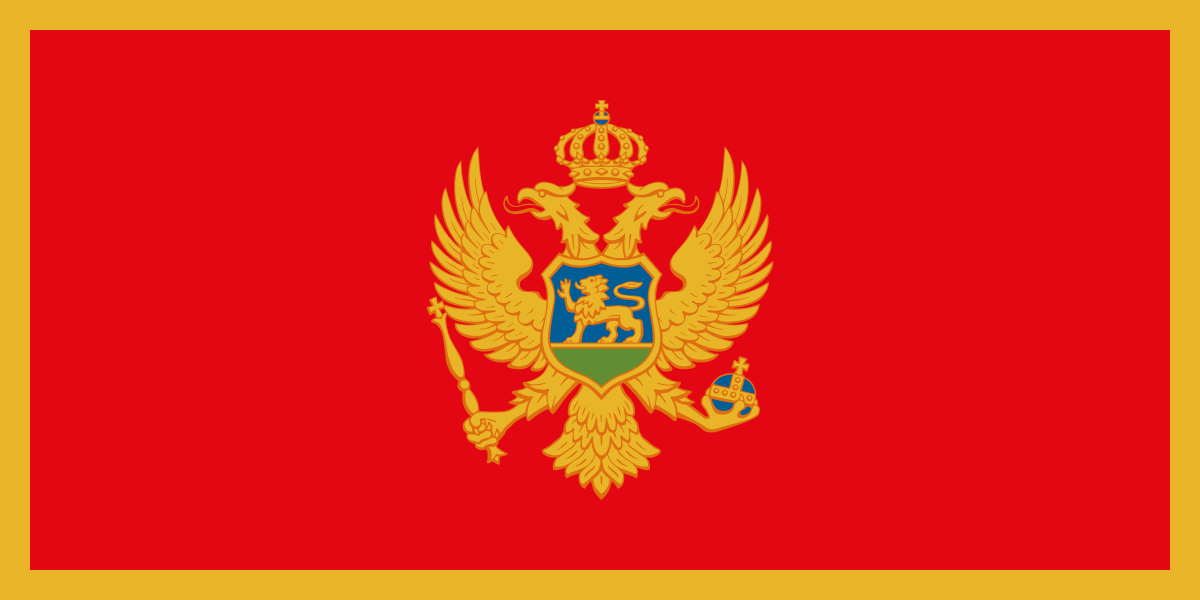
Montenegro
8% · StableMontenegro is unlikely to be directly involved in significant armed conflict in the next three years, with risk concentrated in low-probability NATO–Russia escalation or regional spillover scenarios rather than domestic drivers.
**Bottom line** Three-year direct war risk remains low
Most likely: political churn, protests, and criminal/security incidents managed by police and courts, not armed groups. NATO interoperability and limited modernization continue, while EU conditionality incentivizes de-escalation. Watch for: sustained mass unrest around identity/religion issues, serious security-sector politicization, or a sharp Serbia–Kosovo crisis that raises border and internal security pressures.
Risk stays low but becomes more sensitive to two variables: EU accession success (stabilizing) versus prolonged governance paralysis (destabilizing), and the trajectory of European security (NATO–Russia) plus Western Balkans flashpoints. Even under deterioration, Montenegro is more exposed to hybrid coercion, sabotage, and episodic incidents than to sustained conventional war or civil war.
Threat drivers Montenegro’s main security stressors are political fragmentation, identity polarization, and governance weaknesses that can amplify protests and episodic violence. Organized crime and corruption degrade trust and state performance but typically generate law-enforcement confrontation rather than insurgency. The most credible external pathway is indirect: Western Balkans escalation (especially Serbia–Kosovo) creating spillover pressures, or a broader NATO–Russia deterioration raising the chance of sabotage, maritime/air incidents, or cyber-enabled disruption.
New evidence check (what changes, what doesn’t) Recent commentary highlighting “hybrid pressure” and institutional capture risks points to real vulnerabilities in decision-making cohesion and security-sector integrity, but it is largely inferential and advocacy-toned. More neutral structural indicators still point to continuity: Montenegro remains a NATO member, aligns with EU foreign policy, and is advancing in EU accession chapters and operational cooperation (including border management). Defense modernization and NATO interoperability exercises marginally improve readiness but do not create an offensive capacity or a new motive for war.
Resilience and systemic firebreaks NATO membership remains the dominant firebreak against conventional attack and sharply lowers the expected value of coercive escalation by neighbors. The EU accession process and reform-conditional funding create strong incentives for elites to avoid security crises that would jeopardize membership timelines, investment, and tourism revenues. Geography also favors defense and limits strategic depth for any aggressor, while Montenegro’s small force structure constrains sustained combat operations.
Alliance exposure vs direct kinetic involvement Montenegro’s highest-probability “direct involvement” channel is not unilateral action but alliance dynamics: participation in NATO support roles or being affected by incidents linked to wider NATO–Russia confrontation. Even then, most plausible manifestations are limited and episodic (cyber, sabotage, isolated incidents) rather than sustained armed conflict on Montenegrin territory.
Net assessment Threats have edged up at the margin due to governance fragility and hybrid exposure narratives, but stabilizers dominate. The three-year risk remains low, with probability mass concentrated in rare systemic shocks rather than domestic escalation to war.
Support the Project
WarRiskIndex is a public-good initiative. Your contribution powers AI analysis.