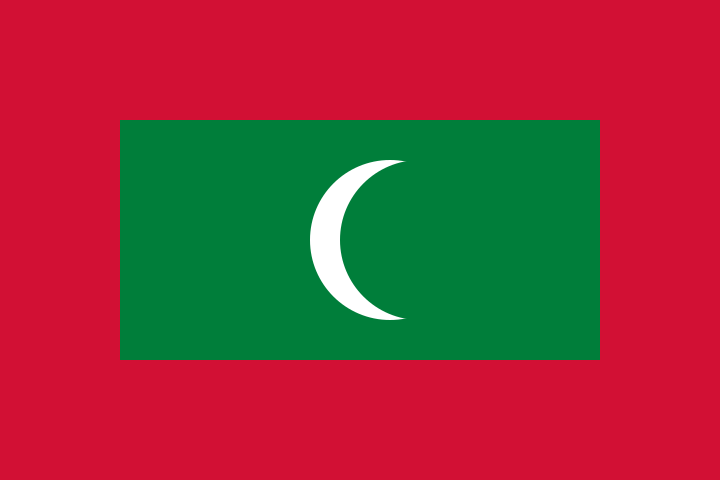
Maldives
7% · StableIt is unlikely (around 7%) that Maldives will be directly involved in significant armed conflict within the next three years, with risk concentrated in isolated terrorism or a rare, localized maritime security incident rather than sustained war.
**Assessment** Three-year conflict risk remains low
Over the next year, expect periodic protests tied to governance and cost-of-living pressures, with occasional clashes but limited escalation potential. Counterterrorism operations will remain active; the highest-impact scenario is a single isolated attack. Maritime patrols and exercises will increase; the main kinetic tail risk is a brief interdiction-related exchange of fire or accident at sea.
Over five years, fiscal/FX stress and continued institutional centralization could increase unrest frequency and marginally widen radicalization risk, raising the odds of sporadic attacks. Maritime security demands will likely grow, increasing incident risk in the EEZ. Even so, limited warfighting capacity, no insurgent sanctuary, and continued external security cooperation keep sustained civil war or interstate conflict unlikely.
Scope This estimates the likelihood of sustained, organized armed conflict involving state forces and/or organized non-state armed groups within three years. It excludes routine crime, isolated riots, and purely diplomatic/economic coercion.
Update versus baseline New material largely reinforces the baseline low-risk view. Defence modernization and more frequent exercises/patrols modestly raise the probability of a short, localized kinetic incident at sea. Domestic governance tightening and fiscal stress elevate unrest risk, but there is still no clear pathway to organized armed rebellion, territorial insurgency, or security-force fragmentation.
Threat drivers Domestic political friction: Centralization and constraints on civic space can generate protests in Greater Malé. The plausible kinetic pathway is protest–police violence; it is typically episodic and self-limiting absent armed factions. Terrorism: Travel advisories and security reporting indicate persistent intent by small extremist networks and lone offenders. Capability appears constrained; the most likely outcome is an isolated attack rather than a sustained campaign that meets a “significant armed conflict” threshold. Maritime/security incidents: Expanded coast guard capability, UAV-enabled surveillance, and increased interdictions (including detentions of foreign vessels) raise the chance of miscalculation, warning shots, or an accidental escalation. This is a brief-incident risk, not an interstate-war trajectory. Geopolitical exposure: India–China competition increases diplomatic pressure, but major partners have strong incentives to keep Maldives stable and commercially open; external military basing remains politically sensitive and constrained.
Resilience and systemic firebreaks Geography and force structure: Dispersed islands, no land borders, and a constabulary-oriented MNDF reduce civil-war and invasion pathways. Economic incentives: Tourism dependence and import reliance impose immediate costs on instability, pushing elites toward de-escalation. External buffers: Ongoing training, maritime domain awareness support, and diversified partnerships improve early warning and crisis management, lowering escalation risk even as operational tempo rises.
Net assessment The dominant risks are isolated terrorism and rare, localized maritime incidents. Structural conditions for sustained civil war or interstate conflict remain weak; overall three-year probability stays low with a slightly fatter tail from increased maritime operations.
Support the Project
WarRiskIndex is a public-good initiative. Your contribution powers AI analysis.