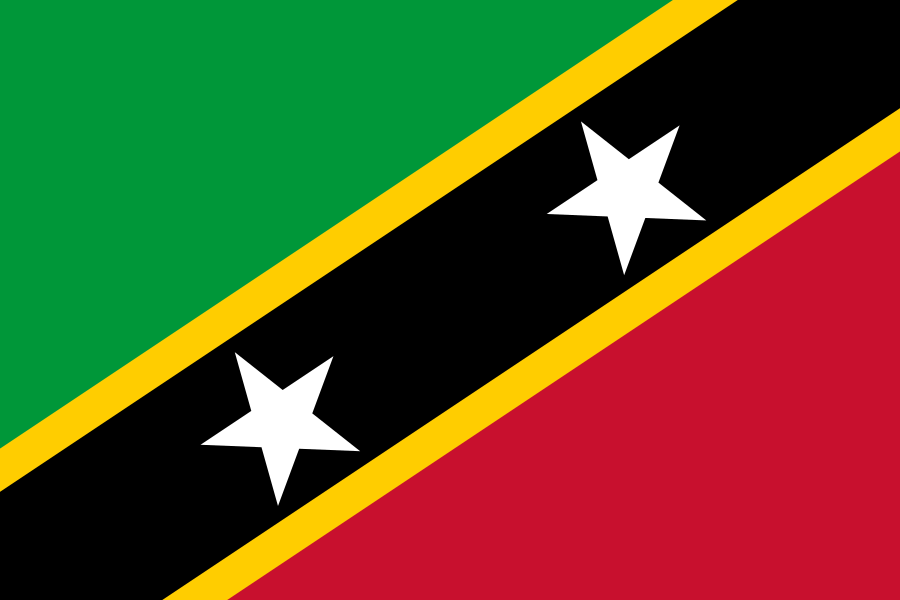
Saint Kitts and Nevis
3% · StableUnlikely: Saint Kitts and Nevis has a low (around 3%) chance of becoming a direct party to significant armed conflict within the next three years.
**Bottom line** Three-year risk remains very low
Over the next year, the main risk remains firearms trafficking and episodic violent crime, not organized armed conflict. Fiscal tightening or a severe storm could strain policing and courts temporarily, but regional cooperation and external assistance capacity should limit escalation. Direct interstate involvement remains highly unlikely.
Over five years, risk would rise mainly through compound shocks: repeated severe disasters plus prolonged fiscal stress that degrades security and justice institutions, enabling more organized criminal coercion. Counterweights include ECCU macro stability, IMF-advised fiscal-buffer reforms, and RSS/CARICOM security and disaster-response mechanisms. Interstate conflict remains near-zero absent wider Caribbean militarization.
Scope and definition This estimates the probability by early 2029 of Saint Kitts and Nevis becoming a direct party to significant armed conflict: either interstate conflict involving its territory/forces, or internal violence reaching sustained, organized armed contention. Ordinary crime, protests, and routine maritime interdictions are excluded unless they evolve into durable armed confrontation.
Threat drivers The dominant risk channel remains transnational organized crime: drug trafficking, illegal firearms inflows, and episodic violent crime. Recent local reporting continues to reflect routine criminal charging and policing activity, consistent with a crime challenge rather than insurgency or factional armed politics. A secondary structural risk is fiscal and disaster vulnerability: IMF reporting highlights sizable deficits, rising debt, and the need for consolidation and buffers. A compound shock (major hurricane plus tourism/CBI revenue drop) could temporarily degrade policing, courts, and border control, increasing coercive criminal capacity. This is a governance-stress pathway, not a typical civil-war pathway.
External escalation exposure Saint Kitts and Nevis has low strategic salience and minimal force-projection capacity. New diplomatic signaling on Taiwan Strait tensions increases political visibility but does not create credible kinetic exposure absent basing, alliance war obligations, or a regional interstate war. Regional instability, especially Haiti’s crisis, is more likely to transmit via migration pressure, trafficking-route displacement, and humanitarian/security cooperation demands than via direct combat involvement.
Resilience and systemic firebreaks Firebreaks remain strong: stable constitutional order; small security forces oriented to internal security, maritime policing, and disaster response; and dense regional/international cooperation (CARICOM and the Regional Security System). Climate-risk workstreams and disaster-preparedness planning also reduce the odds that shocks translate into security breakdown.
Net assessment New evidence does not indicate structural rupture toward organized armed conflict. Maintain the baseline estimate at 3% (unlikely).
Support the Project
WarRiskIndex is a public-good initiative. Your contribution powers AI analysis.