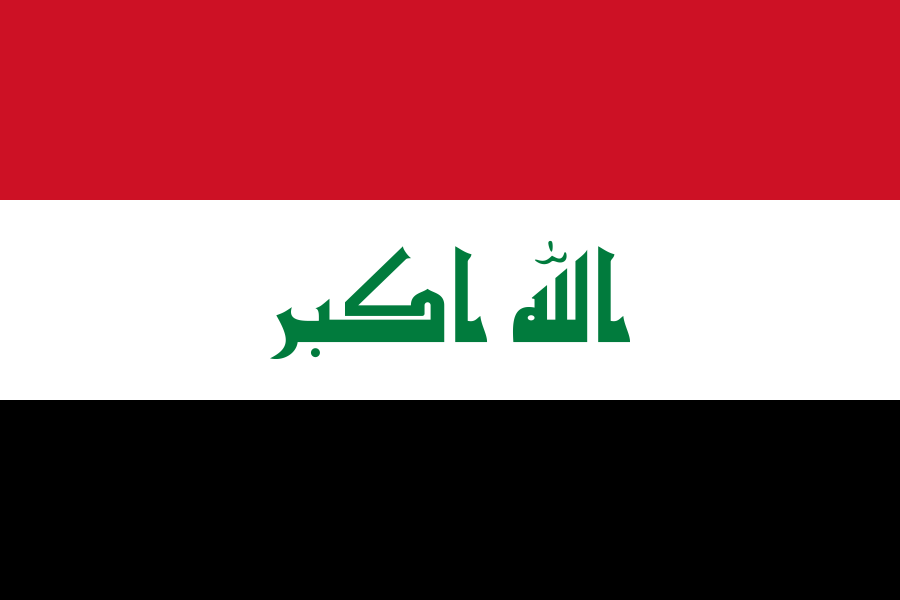
Iraq
55% · High TensionI assess a roughly even-to-likely chance that Iraq experiences significant armed conflict involvement within three years, driven mainly by regional spillover and militia-linked escalation rather than a deliberate state-initiated war.
**Bottom line** Iraq’s main war risk is entanglement: regional Iran–Israel–U
Baseline expectation is contained insecurity: ISIL asymmetric attacks persist in northern/western belts; periodic militia-linked incidents and protests occur, but the state and major factions prefer control over open warfare. The main near-term escalation trigger is a regional spike that produces repeated strikes on Iraqi territory (bases, air defenses, energy nodes) or a mass-casualty attack that compels sustained retaliation.
Over five years, risk hinges on whether Iraq consolidates a monopoly on force and whether the region stabilizes. If U.S.–Iran and Iran–Israel confrontation remains chronic, Iraq likely faces recurring significant strike cycles and coercive episodes. If de-escalation holds and financial/oil governance improves, Baghdad can gradually narrow militia autonomy; violence would persist but trend toward localized insurgency and criminality rather than major war.
Security situation Iraq is not structurally positioned to initiate major interstate war; the dominant pathway is being used as a battlespace or signaling arena by external actors and Iraqi armed factions with uneven command-and-control. Recent UN reporting highlights how regional hostilities can translate into Iraqi airspace violations and attacks on air defenses, airports, and energy infrastructure.
Threat drivers The highest-impact driver is renewed regional escalation (Iran–Israel and/or Iran–U.S.) that triggers sustained exchanges involving Iraqi-based groups, foreign forces, or critical infrastructure. A second driver is fragmented coercive authority: competition within and among state security organs and Popular Mobilization-aligned networks raises the chance that a localized strike, assassination, or base attack cascades beyond Baghdad’s ability to contain. A third driver is persistent insurgent capability: ISIL remains able to conduct asymmetric attacks and exploit border instability, especially if conditions in Syria deteriorate and facilitate infiltration or network rebuilding.
Resilience and systemic firebreaks Several stabilizers plausibly keep Iraq short of nationwide war. First, violence indicators have declined markedly versus prior peaks, and elections have been managed with comparatively limited overt armed contestation, reflecting elite preference for controlled competition. Second, Iraq’s political economy creates restraint: oil revenue and access to the international financial system are central to patronage and state functioning, incentivizing major factions to avoid shocks that threaten exports, reserves, and banking channels. Third, external stakeholders (U.S., UK/EU partners, Gulf states, and Iran) often prefer bounded competition in Iraq over uncontrolled escalation that endangers energy markets and their equities.
Net assessment Compared with the baseline, the structure is broadly unchanged but with clearer evidence that regional flare-ups can generate direct kinetic effects on Iraqi soil and infrastructure. The most likely “significant conflict” scenario is a sustained cycle of strikes and counter-strikes (including drones/missiles) involving foreign forces, militia networks, and/or energy and air-defense nodes, rather than a renewed full-scale civil war. Overall risk remains medium-high.
Support the Project
WarRiskIndex is a public-good initiative. Your contribution powers AI analysis.