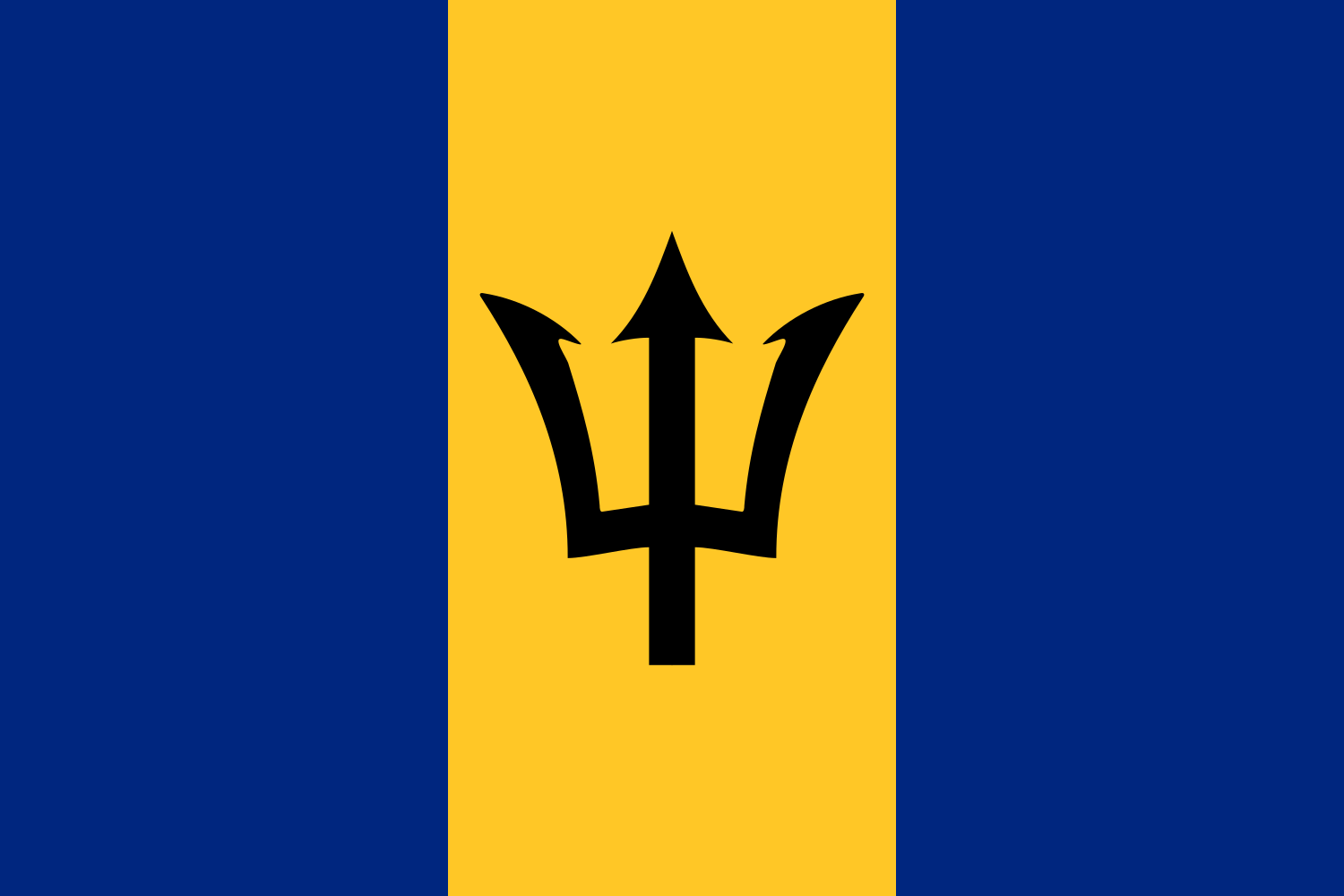
Barbados
4% · StableUnlikely (around 4%) that Barbados will be directly involved in significant armed conflict within the next three years; the most plausible pathway is indirect spillover from transnational crime or a regional contingency rather than interstate war.
**Bottom line** Barbados faces low war risk due to geographic insulation, limited strategic targets, and strong governance
Low risk of armed conflict. Expect continued focus on policing, maritime interdiction, and regional security coordination rather than military escalation. Crime spikes or a high-profile cyber incident could drive temporary emergency measures and partner assistance, but indicators still point to contained internal security challenges, not organized armed conflict.
Risk remains low but could drift upward modestly if regional organized-crime networks intensify firearms trafficking, if economic shocks strain social cohesion, or if cyber threats increasingly disrupt critical services. The most plausible deterioration pathway is chronic criminal violence plus institutional overload, not interstate war. Continued CARICOM security cooperation and governance performance are key stabilizers.
Threat drivers Barbados has no active territorial disputes and minimal incentives for interstate conflict. The realistic security stressors are transnational organized crime (drug trafficking routes, firearms inflows), episodic gang violence, and cyber-espionage/cybercrime that can disrupt government services. Regional instability (notably Haiti’s crisis and periodic Venezuela-Guyana tensions) can create second-order effects such as trafficking, migration pressures, and heightened maritime security demands, but Barbados is geographically removed from the main flashpoints.
Resilience and systemic firebreaks Barbados’ institutional quality and political stability are comparatively strong for the region, reducing the probability that criminal violence or protests transform into organized armed conflict. The state’s small size and centralized administration support rapid coordination across police, coast guard, and disaster-response functions. Internationally, Barbados is embedded in dense diplomatic and security networks (CARICOM cooperation and regional security coordination), which function as de-escalatory mechanisms and provide capacity support short of warfighting.
Alliance exposure vs direct kinetic involvement Barbados is not positioned as a frontline military actor and maintains limited force projection. Security cooperation with partners is more oriented toward maritime domain awareness, law enforcement, disaster response, and counter-trafficking than expeditionary combat. This lowers the likelihood of Barbados becoming a direct belligerent even if regional partners face crises.
Net assessment The structural baseline remains continuity: low interstate threat, high governance resilience, and strong regional/international firebreaks. Recent travel-advisory and media narratives about crime or terrorism risk are better interpreted as public-safety and contingency-planning signals, not indicators of impending armed conflict. The principal risk tail is a severe internal security shock (e.g., sustained gang conflict with high lethality, or a major cyber incident cascading into prolonged disorder), but current indicators do not support a shift to a higher conflict category.
Support the Project
WarRiskIndex is a public-good initiative. Your contribution powers AI analysis.