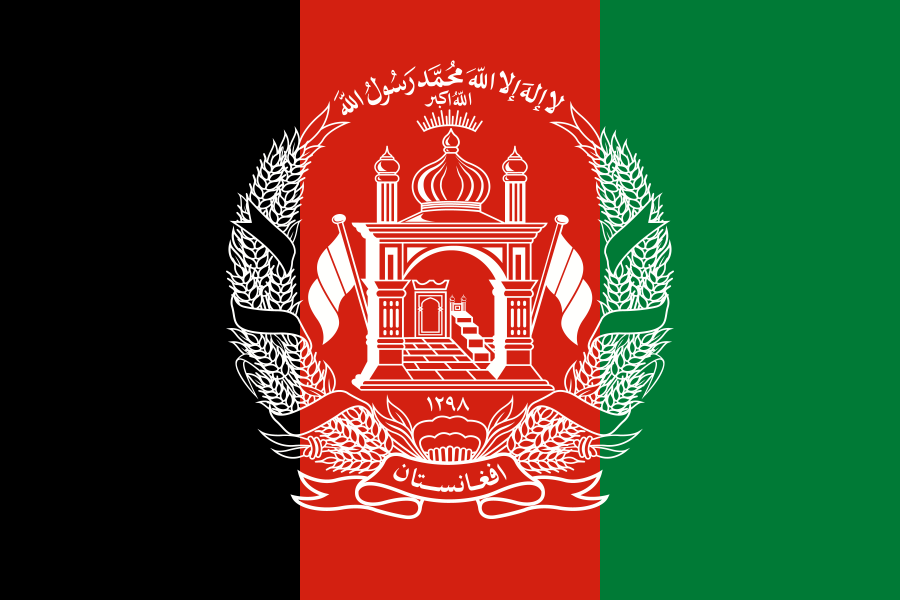
Afghanistan
72% · High TensionAfghanistan is likely (roughly 60–80%) to be directly involved in significant armed conflict within the next three years, primarily through sustained internal militant violence and episodic cross-border kinetic incidents that remain short of full interstate war.
**Bottom line** Afghanistan’s 3-year conflict risk remains high due to persistent ISKP capability, ongoing armed resistance and coercive crackdowns, and…
Violence is very likely to persist but remain geographically uneven. Expect continued ISKP attacks and Taliban counterterror raids, plus periodic resistance attacks and coercive security sweeps. Pakistan-border volatility stays elevated: closures, deportations/returns, and sporadic exchanges of fire are likely; sustained interstate operations are less likely due to Pakistan’s escalation dominance and mutual economic constraints.
Risk remains high and path-dependent. If isolation and humanitarian stress persist while militant sanctuaries remain contested, Afghanistan likely stays in a chronic low-to-mid intensity conflict equilibrium with episodic cross-border incidents. A durable reduction would require credible border security coordination with Pakistan and northern neighbors plus partial economic normalization; a sharp increase would follow a major mass-casualty attack or a prolonged Pakistan–Taliban kinetic cycle.
Risk definition “Direct involvement” is most plausibly met via sustained internal armed violence (ISKP terrorism, localized resistance activity, Taliban counterinsurgency and repression) and limited but lethal cross-border kinetic episodes with Pakistan or, less likely, northern neighbors. Expeditionary war is not a realistic pathway.
Threat drivers Internal security remains the core risk. Multiple reporting streams continue to describe an active militant ecosystem, with ISKP retaining intent and demonstrated capacity for mass-casualty attacks designed to delegitimize Taliban rule and provoke sectarian and regional spillover. Parallel to this, anti-Taliban armed groups appear capable of periodic attacks and assassinations, which can trigger heavier Taliban security operations and localized cycles of violence.
The second driver is Afghanistan–Pakistan escalation risk. Pakistan’s domestic militant pressure creates recurring incentives for coercive border measures and occasional strikes when Islamabad attributes attacks to TTP-linked sanctuary dynamics. Recent reporting of renewed exchanges of fire and prolonged border closures is consistent with a pattern of tit-for-tat incidents that can produce civilian casualties and displacement even without a deliberate decision for war.
A third, lower-probability driver is northern border volatility (notably Tajikistan), where repeated armed incidents attributed variously to militants or traffickers increase the chance of firefights and political escalation, though both sides signal interest in coordination mechanisms.
Resilience and systemic firebreaks The Taliban’s strongest stabilizer is coercive territorial control and a regime-survival preference that biases toward suppressing challengers rather than widening external fights. Afghanistan’s limited airpower, logistics, and sustainment capacity constrains its ability to prosecute interstate conflict. Pakistan’s conventional and nuclear overmatch, plus economic leverage via border management, discourages Kabul from sustained escalation. Regionally, China, Russia, Gulf actors, and Central Asian states prioritize containment and connectivity, supporting de-escalation channels even amid diplomatic strain.
Net assessment New evidence reinforces, rather than overturns, the baseline: a “violent but bounded” equilibrium is the modal outcome. The main upside risk is a high-casualty ISKP attack or a major Pakistani strike that triggers a longer cross-border kinetic cycle; the main downside risk is improved border coordination and partial economic normalization that reduces incentives for kinetic signaling.
Support the Project
WarRiskIndex is a public-good initiative. Your contribution powers AI analysis.